


the project
Alongside designers Alex Ciupac, Vicky Nguyen, and Belle Zhu, we were prompted to identify, ideate, and design solutions to problems affecting university students. As university students ourselves, surrounded by our peers, we were tasked with two milestones: our problem and our solution. The solution was to be a mobile application, including a high-fidelity prototype of the app.
The problem
One of the most exciting things about university is the diverse community and plethora of events. We wanted to design an app that is not only a hub for all sorts of events, but also allows a student to plan around academic commitments. The goal of the app is to improve the social lives of students, and have events/communities for any student.
milestone 1
Identification
In order to understand the extent as to how
affected university students truly were, my teammates and
I each interviewed three university students of
varying stages in their education. After, each
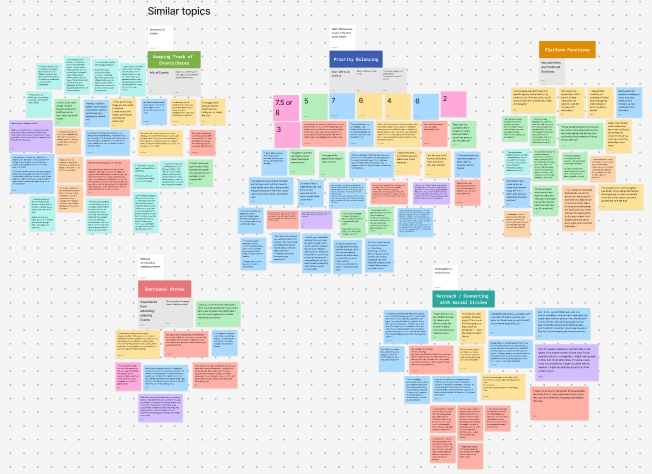
interview was summarized and common topics
were grouped together to identify typical issues.
Every interview followed the same format and line
of questioning. The topics were all grouped using
sticky notes.
The final common issues were:
- Keeping track of events/dates
- Personal work/life balance
- Emotional stress during events
- Lack of diversity due to social circles
Personifying
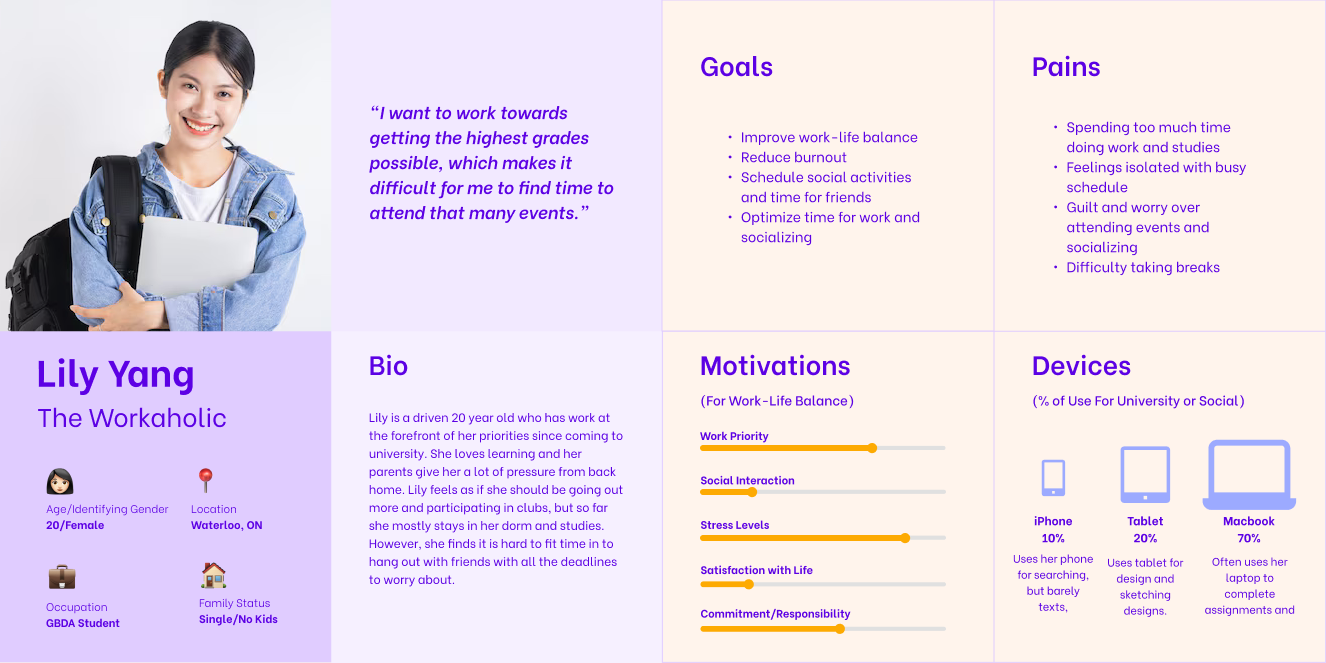
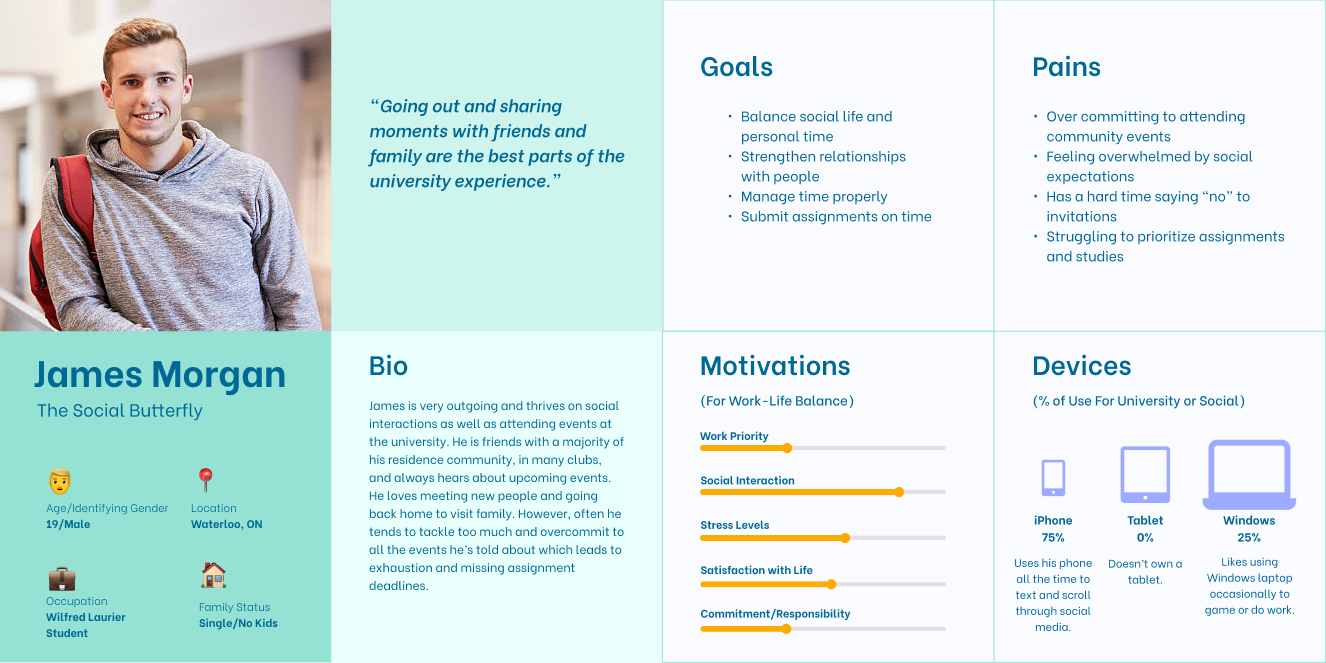
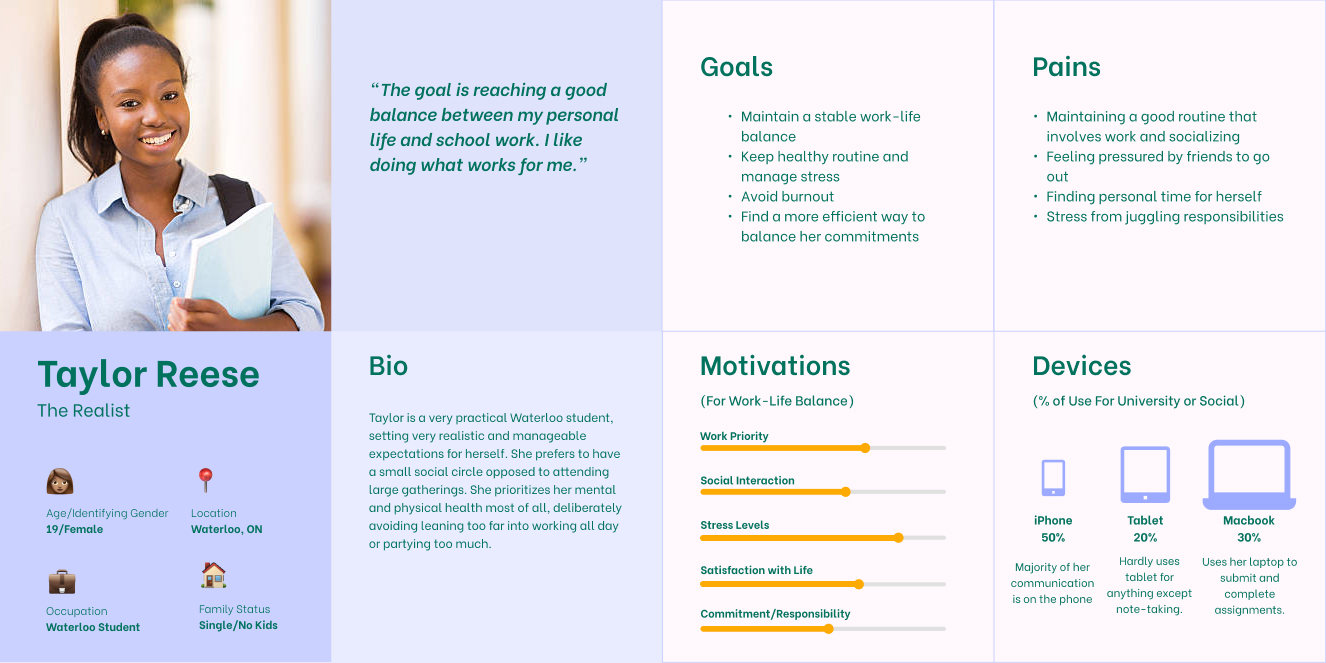
After naming common issues, we identified personas within archetypes of interviewees. The personas we discovered were:
- Workaholic
- Social Butterfly
- Realist
Wants to but doesn't go to events in favour of completing assignments on-time, even if they have free time.
Prioritizes social life and attending events over work but suffers academically for it.
Does their best to balance their work and social life, but doing worries over managing things properly.
These personas were then used to identify possible actions for users to take when using our app solution. How would they want to find social events and organize their school deadlines? Did they want to share events with their friends and plan around them? These questions were essential to answer, and we wrote out a comprehensive list of possible user actions. This was essential before moving into our second milestone, aka our prototyping stage.
Milestone 2
Pre-Prototyping
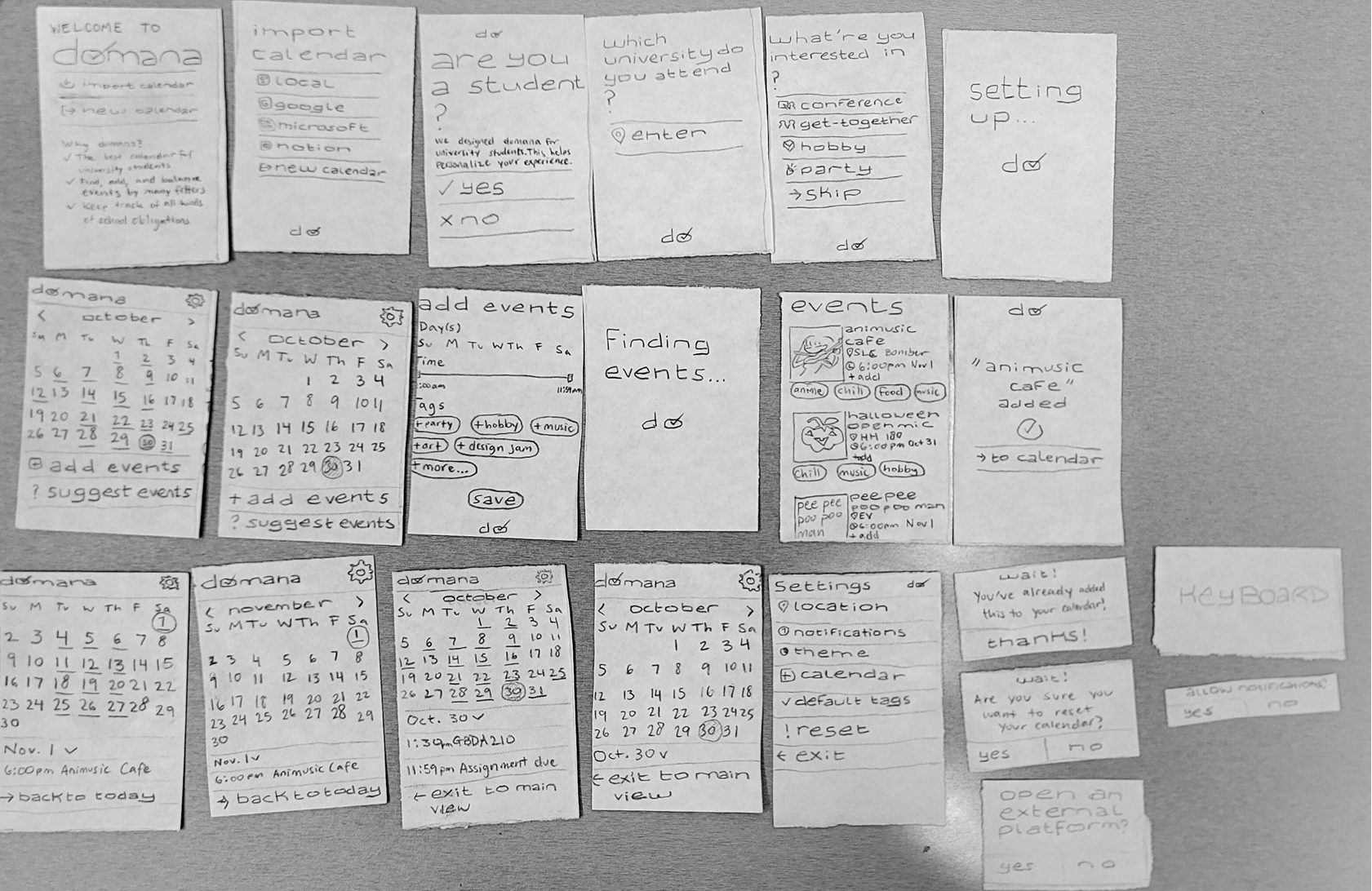
Each of our team members developed a low-fidelity paper prototype of an app concept. I created a simple calendar app that could import a prior calendar, then find events that were available on its database. It was meant to be simple and limited in function, to ensure that the primary purpose of productivity was focus. The name "Domana" came from combining the words "to-do" and "management".
Prototyping
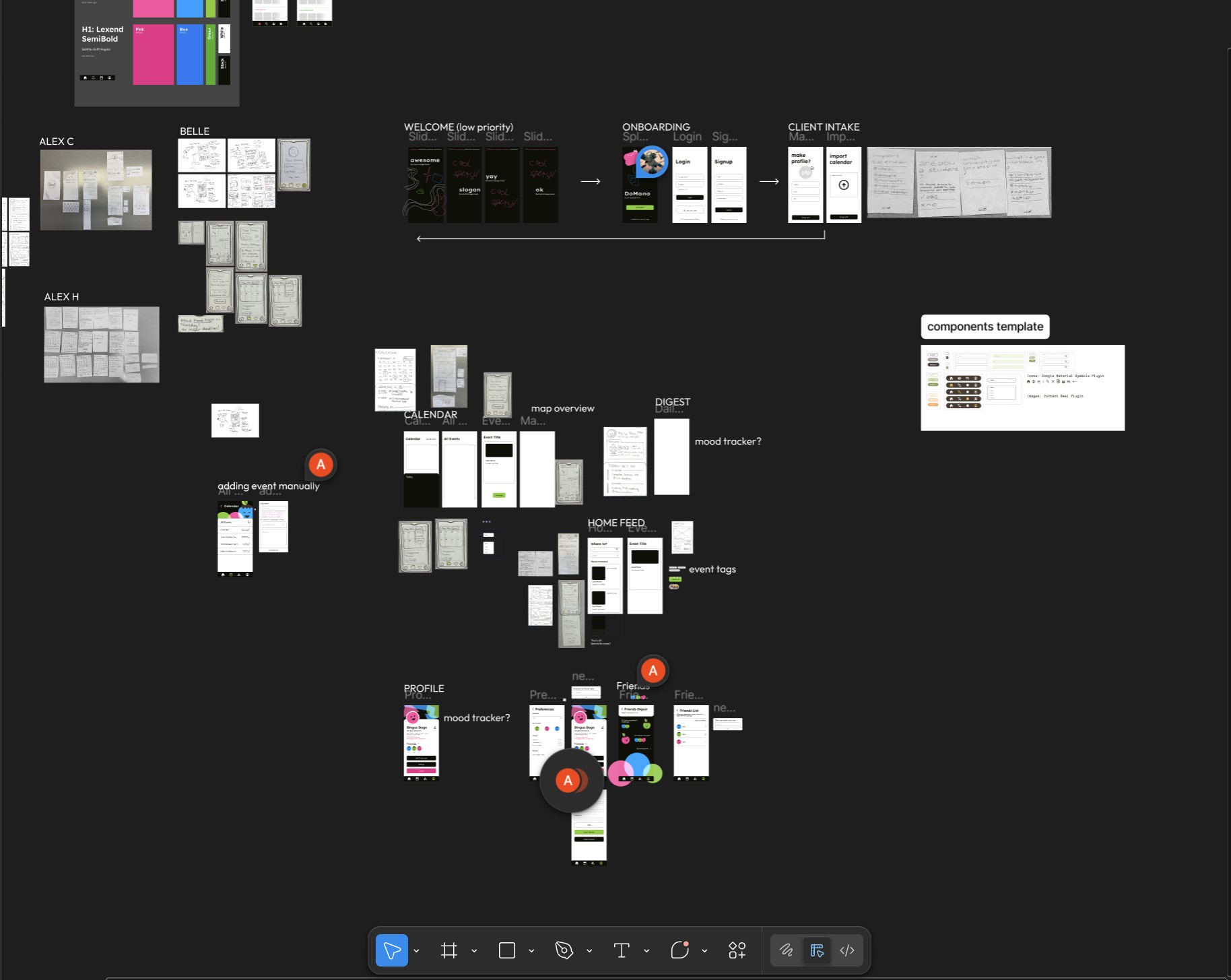
After we each had developed our own possible solutions
based on our research results, we came together and developed
a userflow based on the prototypes we thought were the most
feasible. We modelled it heavily over my prototype, and as
such began calling our project "Domana".
We drafted our usability workflow using Figma. Throughout
the entire process, my teammate Vicky brought her strong
proficiency in Figma to our team. This emboldened our
progress greatly, and Domana would not be the same without
her work.
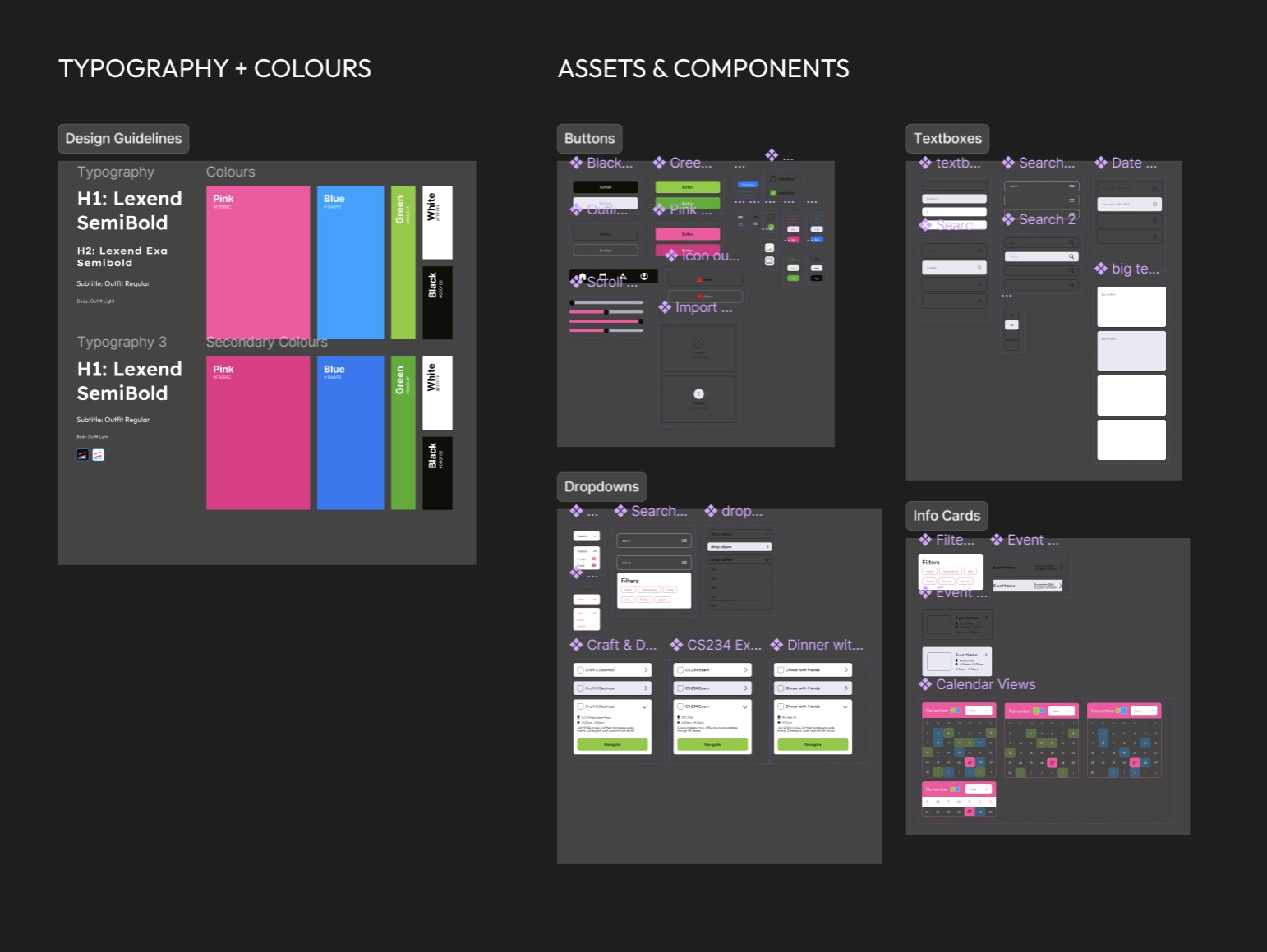
Following the userflow design was a comprehensive design
system. The app had to appeal to students in a fun manner
while also keeping a professional edge. As such, bright colours
paired with darker accents made an appealing colour palette
(inspired by branding such as Nickelodeon).
We also wanted to incorporate smaller fruit-style mascots and
leaf motifs, as "mana" is often used to refer to forms of life.
Similarly to Nickelodeon's branding, we balanced the cute and vibrant
fruit with simpler font choices.
High-Fidelity Prototype
User testing
Before calling our high-fidelity prototype complete, we had a
version in a somewhat-complete stage. While all of the primary
functions were available and it looked very well visually, we
wanted to ensure that users outside of our design team were able
to use its functions. We conducted six tests with first-time users and utilized a
System-Usability Likert Scale (SUS) test to define what needed
fixing.
All first-time users found Domana very easy to use, with
little-to-none need for guidance on functions. Many found that
the app satisfied what they would expect from a scheduling
solution, and had some feedback in the form of a few
quality-of-life fixtures. They were also likely to recommend
Domana to friends if the app existed in a commercial form.
Final version
The version you see here is the final form of our prototype.
Feel free to use it! While there are still a few bugs and
issues, in the end it was a labour of love. We're proud to
call Domana ours.
Domana was created by myself, in conjunction with my peers
Alex Ciupac, Vicky Nguyen, and Belle Zhu.